
Ancient Timeline
Notable ancient events involving or affecting homosexuality
This list is not exhaustive and only includes some notable historical events chosen by the editor. Additional sections will be added at a later time.
335 BC- Middle Ages
The Sacred Band of Thebes
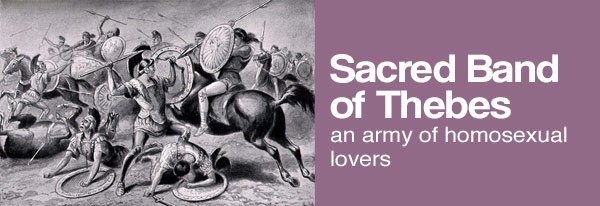
Probably one of the lesser-known milestone events in homosexual history was recorded (with qualifications) by the Greek historian Plutarch. The Sacred Band totaled 300 men hand-picked from the existing Theban army to act as an “elite” military force entrusted with specific military actions. It was made up of 150 pairs of male lovers, probably a combination of a younger soldier and an older mentor type. The rationale was that lovers could fight more fiercely than strangers who had no personal bonds. The Sacred Band, under Theban general Pelopidas fought and defeated the renowned Spartan army at The Battle of Tegyra in 375 BC, routing an army of over 1,000 strong. It was also responsible for the victory at Leuctra in 371 BC. The Sacrad Band remained undefeated until the 338 BC invasion of Thebes by Phillip II of Macedonia and his son- the future Alexander the Great. At the decisive Battle of Chaeronea, the Thebans finally broke and fled the battlefield under overwhelming odds- all except for the Sacrad Band, who stood their ground and fought to the death. On seeing the corpses of these brave, homosexual Theban soldiers, strewn across the battlefield, Phillip exclaimed “Perish a man who suspects that these brave men either did or suffered anything unseemly”. In approximately 300 BC Thebes erected a giant stone lion to the memory of that battle and The Sacred Band. After crumbling and being overgrown for thousands of years the statue was rediscovered by tourists in 1890. After excavation 254 skeletal remains were unearthed- arranged in rows of seven. In the early 20th Century the lion was reconstructed as an endearing monument to the ancient battle and these brave gay soldiers. primary reference: www.sacredband.com/Thebes
Alexander the Great

Photo attribution: Macedonia Warrior on a Horse Dennis Jarvis License CC BY 2.0 SSon of Phillip II of Macedonia Alexander was tutored by Aristotle and then, after his father’s death, he reestablished the overlordship of all of Greece and continued on by conquering Persia, Egypt, and parts of India and Asia. A master military strategist Alexander was also well known for his love for long-time companion Hephaestion who was a highly respected general himself and a member of Alexander’s personal bodyguard. It is noted that both men were extremely handsome with very striking features. While returning home from conquests, Hephaestion died suddenly at Ecbatana. Alexander was overwhelmed with grief. He petitioned the oracle at Siwa to grant Hephaestion divine status, and he was honored as a Divine Hero. At the time of his own death eight months later, Alexander was still planning lasting monuments to his memory. Even though Alexander married an Asian princess, probably for political reasons, it was obvious that Hehaestion was the love of his life and together it was this gay couple who conquered the known world. primary reference: http://wikipedia.org/wiki/Hephaestion
Roman Emperors
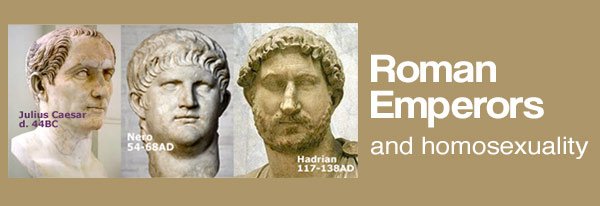
It was socially acceptable for a freeborn Roman man to want sex with both female and male partners. The behavior's morality depended on the partner's social standing, not gender. Both women and young men were considered ordinary objects of desire. It was noted that even though he was married and had an affair with Cleopatra of Egypt Julius Caesar, had a few intimate relations with men. However, Emperors such as Caligula and Nero had more noted Homosexual liaisons. Both were highly unpopular, and their self-serving use of the office of the emperor only hastened their assassinations. However, perhaps Hadrian was the best-known gay Roman emperor; much like Alexander centuries before, he had a well-established lover-the youthful Antinous. Hadrian also became grief-stricken at his untimely death by drowning in the Nile in 130 AD. Hadrian died of advancing age, a well-respected Emperor by the Roman people. Indeed, history has placed him on the list of "good" emperors, a worthy successor to the optimus princeps Trajan. Hadrian played a significant role in developing the empire's foreign policies and its continuing centralization in administration. He also went far in creating a high appreciation of the arts and was the builder of the wall in Northern England, which marked the empire's northern boundary and still bears his name, "Hadrian's Wall." photo attribution: http://www.history.com/photos/roman-leaders-and-emperors/photo12 http://www.reformation.org/roman-catholic-myth.html primary references: http://en.wikipedia.org/wiki/Homosexuality_in_ancient_Rome http://gayinfluence.blogspot.com/2011/11/trajan-hadrian-successive-homosexual.html
Byzantine Period

Atributions: http://ancienthistory.about.com/cs/people/p/constantine.htm http://www.reformation.org/roman-catholic-myth.html In about 300 AD, control of the Roman Empire began to pass from West to East, coinciding with emperor Constantine's rise and acceptance of Christianity. However, the rise of Christendom started to spell trouble for previously accepted homosexual lifestyles and relationships. In 314, during the reign of Constantine, the council of Ankara, which represented the Eastern European Church, excluded the Sacraments for 15 years to unmarried men under the age of 20 who were caught in homosexual acts. In 342, Christian emperors Constantius II and Constan made same-sex marriage illegal. The broadening of Christianity also brought further persecution of gays as well as Jews and other minorities. The ultimate end of homosexual acceptance came under the reign of emperor Theodosius when in 390, he declared homosexual sex illegal, and those who were guilty of it were condemned to be burned alive in front of the public. Theodosius was the last emperor of what could be called a united empire. After his death, the West splintered into various national factions while the East evolved into the Byzantine Empire. primary references: http://wikipedia.org http://www.fordham.edu/halsall/pwh/just-novels.asp
The Middle Ages

photo attribution: Templars on Stake Annonymous License CC BY 2.0 The sacking of Rome in 410 AD by the Visigoths marked the end of the Roman Empire and the beginning of the middle ages. It also marked the end of acceptance or any ambivalence towards homosexuality that previously existed in the ancient world. With the growth of Christianity and the sometimes inaccurate interpretation of biblical writings by contemporary scholars and churchmen, the condemnation of homosexual practices that began in the Byzantine era even became associated with satanic acts in some regions. The underlying Christian-driven theme that developed was that sex of any kind was not necessarily to be enjoyed but only necessary as a means to procreation. A special note in the timeline of homosexuality occurred during the late Crusades. The Knights Templar, a small band of “special forces” knights tasked with guarding pilgrimage routes to Jerusalem, began to grow in influence- an influence that did not sit well with the king of France. In 1307, members of the Templar order in France were suddenly charged with heresy and homosexual practices and arrested. Many Knights were found guilty and burned at the stake or imprisoned for life. These events contributed to viewing homosexuality or homosexual acts as akin to witchcraft and punishable by death. primary reference: http://www.historytoday.com/helen-nicholson/saints-or-sinners-knights-templar-medieval-europe
Kings of the Late Middle Ages
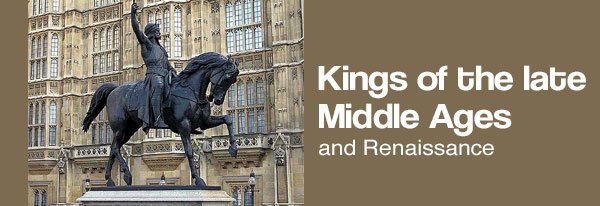
photo attribution: Bronze Sculpture Richard I (cropped to fit) Adrian Pingstone License CC 2.0 The persecution of homosexuals continued throughout the late middle ages, reaching a high point (or low point, depending on one’s outlook) during the Inquisition era of the mid-13th to 15th centuries when much of Europe was undergoing the persecution of Jews and other minorities. However, a new light was soon to dawn with the Renaissance and the Reformation of the 16th Century. During this time, the British monarchy evolved, and more than one gay king reigned during these centuries. A short list of those rumored to be gay includes William “Rufus” 1087-1000 – unpopular openly gay son of William the Conquerer Richard I “The Lionheart” 1189-1199 – one of England’s more successful monarchs with many rumored trysts Edward II 1307-1327- a poor soldier but a well-known lover of many men in court including a long term affair with Piers Gaveston- a Gascon Knight. Richard II 1377-1400 – He ascended the throne at only ten years of age and was never a capable statesman, monarch, or soldier. However, he was a prominent supporter of the arts and went far in adding a high degree of culture to the English court. James I 1603-1625 – Again, not the most capable of kings, he did sponsor a new writing of the Bible and was a known homosexual being quite fond of young men. And one queen, Anne 1702-1714 – Although married, she had more than one miscarriage and was rumored to have a long-term affair with Sarah Churchill, Duchess of Marlborough primary reference: http://notaparticularlygreatdancer.wordpress.com/2011/05/04/gay-monarchs-of-the-united-kingdom/
Renaissance - 19th Century
The Renaissance - Florence
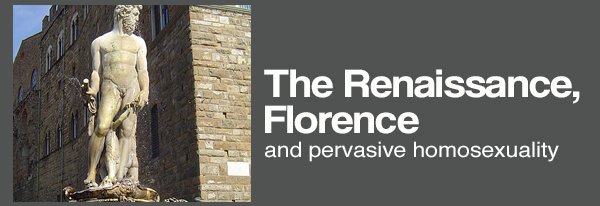
photo attribution: Florence Italy Ronen Perry License: CC BY 3.0 A combination of elements seems to have converged in the high Renaissance in Florence, Italy, which created an environment of male-to-male sexual gratification. With much of Europe still reeling from the scourge of the Black Death of the 1300s and with parents being overly protective of the virtues of their younger daughters, a disproportionate number of sexually active males began resorting to same-sex sexual fulfillment. Of only about 40,000 total population in Florence in the mid-1400s approximately 17,000 men were found guilty of liaisons of sodomy. These accusations occurred during the tenure of an investigative panel called “The Office of The Night,”- composed of clerics and set up in the early 1430s to investigate growing claims. Some speculation also exists that such appreciations of the male as a sexual object were enhanced by the growing Renaissance views of the classic male as an object of beauty. This attitude could have contributed to males who already had homosexual yearnings to more openly express their desires- or “come out.” Primary reference:http://igfculturewatch.com/1998/05/28/homosexuality-in-renaissance-florence/
Japanese Samauri

photo attribution: Samurai public domain Felice Beato As part of the Taihō Code and the Yōrō Codes of the 700s AD, the developing Japanese population was ordered to report regularly for national conscription. Then Emperor Mommu introduced a law in which 1 in 3 or 4 adult males was drafted into the national military, which developed into a warrior class – better known to the West as “Samari”. As the style developed, boys and younger men were brought into the fold and were usually “apprenticed’ to an older male from which the warrior arts were learned. Quite often, this pairing could develop into a homosexual relationship known as shudō, abbreviated from wakashūdo, the “way (do) of wakashū. This behavior soon overflowed into the middle class as Japanese culture developed and became an integral part of Kabuki or stage theatre, where young actors often worked as male prostitutes off-stage- to both male and female clientele. The wakashūdo was finished with the eventual elimination of the Samari class in the late 1800s and the “Westernization” of Japan. Primary reference: http://en.wikipedia.org/wiki/Homosexuality_in_Japan
TheTudors and the Buggary Act
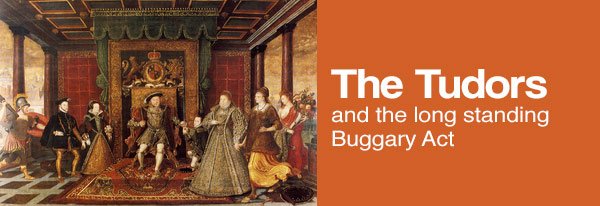
photo attribution: Family of Henry VIII Lucas De here- Public domain It was during the back and forth of the religious affiliations of the Tudors in 16th century England that homosexual acts were first addressed. The Buggery Act of 1533, as sponsored by King Henry VIII, was probably just another element wrapped into his whole schism with the Catholic Church. With the passage of this law, accusations of sodomy and bestiality, with a guilty verdict, would be punishable by death, with ensuing confiscation of all properties of the guilty party. During the brief reign of Henry’s son, Edward VI, the act was adjusted in 1548 not to include the forfeiture of any goods or lands, although a death penalty was still decreed. When Henry’s first daughter, Mary, a staunch Roman Catholic, ascended the throne in 1553 she did away with many of the acts and laws established during her father’s and half-brother’s reigns and included in this was the Buggery Act. However, this reversal was short-lived because when Elizabeth I, Mary’s half-sister, became queen in 1558, she RE-established many of these laws. The Buggery law remained in effect in its original form until the late 1800’s when such acts were decriminalized to a simple misdemeanor. Then in 1967 the law was basically discarded. Interestingly, many of England’s territories and colonies kept sodomy laws on the books until the present day, including different regions in the United States. Primary references: http://www.fordham.edu/halsall/pwh/englaw.asp http://www.tudorplace.com.ar/Documents/the_buggary_act.htm
Expanding Puritanism
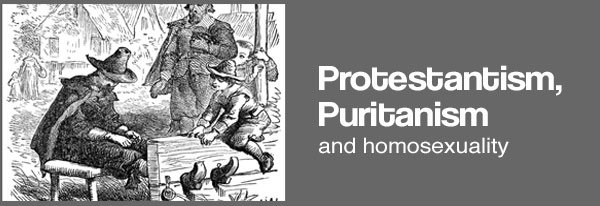
photo attribution: http://ushistoryimages.com/puritan-life.shtm From the mid-1500s through the 17th-century social views of homosexuality evolved with the Reformation of the church in England and other European countries. In the old church, homosexuality wasn't really identified as it has been in contemporary times, and the act of sodomy was almost tolerated or at least not a high-priority concern. Some scholars believe that to combat unwanted procreation in poor societies wanting not be overburdened with too many children that sodomy was resorted to as a means of birth control. However, with the advent of the Reformation, many previous religious authorities were assumed by secular governance, and actual laws were established which directly addressed sodomy. Examples of this were the Holy Roman Empire's transition to Protestantism and making sodomy punishable by death in 1552 and King Henry of England and the Buggery Act the following year. Besides changing views on sexuality, many of these laws were established to counter the perceived leniencies of the old church. At the same time, a central tenant of growing Protestantism was the ability for clergy to marry. The move away from celibacy further evolved into a genuine encouragement for them to marry and thus procreate, which ran hand in hand with the Protestant attitude of the high importance of family. This family ideal was further intensified with the Puritanism of the 16th and 17th centuries, where sex was viewed as only something that occurred between man and wife, demonizing all sexual acts outside of marriage, which included any same-sex acts. Primary references: http://garnlebaron.wordpress.com/sexual_relations_in_renaissance_europe/ http://en.wikipedia.org/wiki/Timeline_of_LGBT_history
Revolutionary France
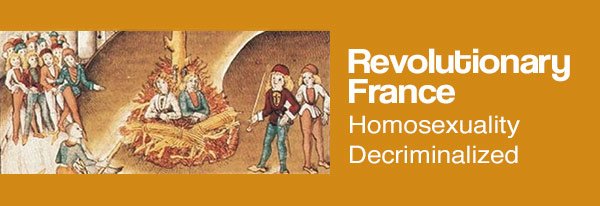
photo attribution:
Jean Diot and Bruno Lenoir were the last Frenchmen burned at the stake for homosexuality on July 3, 1750. © Les Conseils de Quartier de 2e Homosexuality was a relatively low priority in revolutionary situations throughout history. France had outlawed homosexuality since the 1200s, castrating convicted offenders. However, after its revolution, France’s new legislative body codified many of its laws into the Penal Code of 1791 but omitted the homosexuality ban. It was the first time since classical antiquity that a Western government had decriminalized homosexuality.
In presenting the new legislation to the French parliament, lawmaker Louis-Michel le Peletier explained that only “true crimes,” and not “those phony offenses created by superstition,” would be outlawed.
However, today, in France, like many other countries, homosexuality has evolved into a devise issue, especially with the current same-sex marriage debates. Here is a timeline on marriage and the rights of homosexuals in France. 1791 – Following the French Revolution, the penal code is amended to decriminalize homosexual acts. But social disapproval in the traditionally Catholic country remains strong until recent years. 1995 – Saint Nazaire became the first city to allow homosexuals to register as concubines, a legal concept allowing limited shared rights for unmarried couples. 1999 – The National Assembly approves “civil solidarity pacts” (PACS) after heated debates but few protests. Open to all; they provide many tax breaks granted to married couples in joint tax returns. The PACS is a contract certified by a court clerk without a civil wedding ceremony and could be terminated in writing to the court. Partners retain their assets separately, and there is no duty to provide for a former partner. 2001 – Bertrand Delanoe, a Socialist who was one of the first French politicians to declare his homosexuality publicly, is elected mayor of Paris. Since then, an openly gay man and an openly bisexual man have served as culture ministers in conservative national governments. 2004 – Two men are married by the mayor of Begles near Bordeaux in France’s first same-sex marriage. A court later declares their union null and void because the civil code indicates that marriage involves a man and a woman. 2006 – A parliamentary report recommends expanding taxation, property, and succession rights in civil unions but keeping bans on marriage, adoption, and assisted reproduction. It maintains that extending those rights to gay couples would violate the United Nations Convention on the Rights of the Child, which France has signed. No action is taken on this report. 2010 – Originally seen as a kind of gay union, the PACS gradually morphs into “marriage lite” for heterosexuals. In 2010, there were 251,654 heterosexual marriages and 205,558 civil unions, 94 percent of them between heterosexuals. The term “pacsé” enters into current usage to describe someone in this status between single and married. 2012 – Francois Hollande includes gay marriage as one of 60 campaign promises, but it does not figure highly in debates for the presidential election in May. In November, the cabinet approved a draft law allowing same-sex marriage with adoption rights that will be presented to parliament on January 29, 2013 – On January 13, Catholics, conservatives, Muslims, evangelicals, and homosexuals opposed to same-sex marriage marched in Paris in the first major street protest against President Francois Hollande.
source: http://www.reuters.com/article/us-france-gaymarriage-time-idUSBRE90C0AO20130113
Mother Clap & the Molly Houses

photo attribution: http://rictornorton.co.uk/molly.htm Even though “sodomy” was still illegal in England then, private underground retreats for gay men developed into “Molly Houses” in the early 1700s. The term “Molly” was slang for effeminate, usually homosexual males. Many of these underground houses existed in one form or another right through the 19th Century. Perhaps the most famous Molly House was “Mother Clap’s,” which was eventually raided and shut down in 1726. Her house could house upwards 0f 35-40 men at any one time. What set Mother Clap away from many other places of the type was she operated more as a boarding house and not so much as a money-making male brothel. It appeared that she cared for many of the “residents” with meals and drinks, and she became a well-respected figure in the homosexual underground of the time. The final raid on the house was caused by a “Molly” who was jilted by a lover and thus turned the house onto the police. In recent years, Mother Clap’s Molly House has become the source for books and bawdy stage performances. Primary reference: http://en.wikipedia.org/wiki/Margaret_Clap
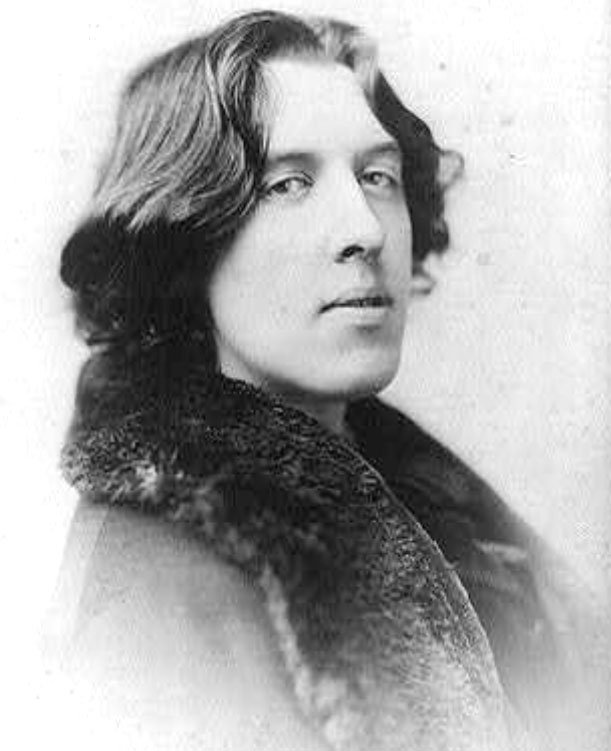
Photo:public domain-
Oscar Wilde by Sarony 1882 04 cropped BW.tif
Oscar Wilde
photo attribution: Library of Congress. No known resrictions on publication.
One of the best-known cases of gay “outing” occurred during the Victorian Era in England. The famous playwright, born in 1854, penned such classics as “The Importance of Being Ernest,” “The Picture of Dorian Grey,” and other renowned works. He was ultimately “outed” by a lover’s father, who discovered their long-term affair. Although married with two children, Oscar’s preference for men may have begun as early as 16. Ultimately it was his affair with Lord Alfred Bruce Douglas which became his undoing. Upon discovering the affair Douglas’ father, the Marquis of Queensbury, publicly accused Wilde of sodomy. In response, Oscar Wilde took the Marquis to court, charging him with criminal libel. However, during the trial, many “improper” liaisons with various “rent-boys” were revealed. The trial was well publicized, and Wilde was subsequently sentenced to two years of hard labor. During his imprisonment, he became deathly ill and almost died. The “outing” and trial destroyed the career of this brilliant playwright. He ultimately passed away at the young age of 46. Primary reference: http://plays.about.com/od/playwrights/a/oscarwilde.htm